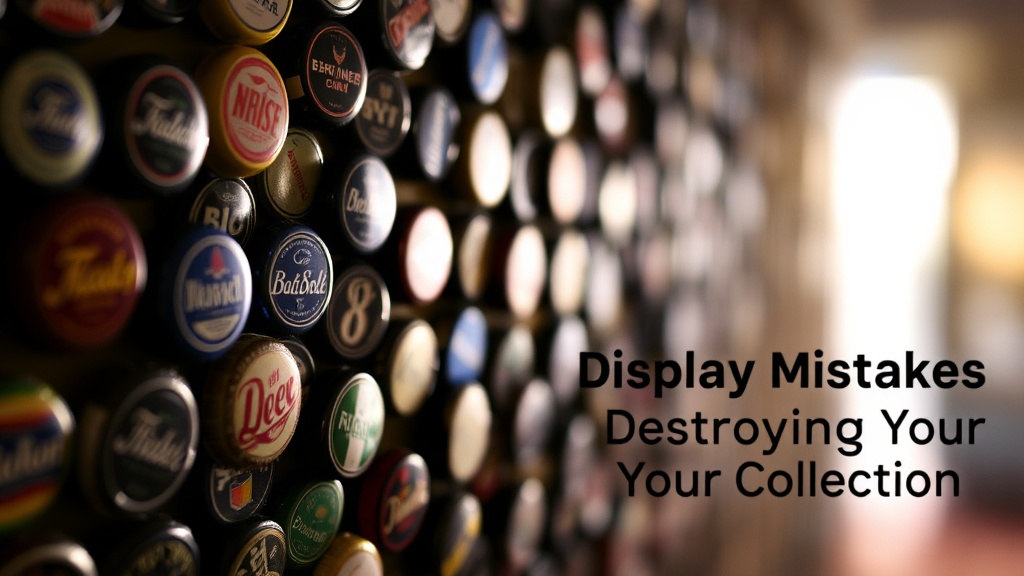
Protect Your Beer Caps: 5 Display Mistakes Destroying Your Collection

Quick Tip
Always display beer caps away from direct sunlight and use UV-protective glass to prevent fading and discoloration.
This post covers five common display mistakes that quietly damage beer cap collections — from UV exposure to poor mounting choices — and provides practical fixes to preserve both condition and value. Whether you've got 50 caps or 5,000, how they're stored directly impacts what they're worth.
What's the Worst Place to Display Beer Bottle Caps?
Direct sunlight is the single biggest threat to any collection. UV rays fade colors in months, turn glossy finishes dull, and can make older metal caps brittle. Here's the thing — that sunny windowsill looks great for photos, but it'll wreck a vintage 1940s Ballantine cap in under a year.
Heat compounds the problem. South-facing rooms, attics, or spaces above radiators create temperature swings that warp caps and loosen liners. The ideal spot? A climate-controlled room away from windows, with stable humidity between 40-60%. Basements work if they're dry — moisture invites corrosion and mold.
Should Beer Caps Be Stored in Airtight Containers?
Not necessarily — and in some cases, absolutely not. Airtight containers trap moisture, especially if caps aren't completely dry when sealed. Condensation builds up. Rust follows. That said, open-air displays aren't the answer either; dust settles into crevices and acids in the air gradually dull finishes.
The sweet spot? Archival-quality options with controlled airflow. Consider the Gaylord Archival Classic Box for bulk storage, or UV-protected acrylic cases for display pieces. The catch? Even the best container won't save caps that go in damp.
| Container Type | Best For | Avoid If |
|---|---|---|
| Archival cardboard boxes | Long-term bulk storage | High-humidity environments |
| UV acrylic display cases | Showcasing rare pieces | Direct sun (even UV-rated has limits) |
| Glass jars with silicone seal | Moderate collections | Caps aren't bone-dry |
| Mounting boards with adhesive | Wall art (temporary) | Valuable or vintage caps |
Why Do Beer Caps Rust Even Indoors?
Humidity is the culprit — and it's sneakier than most collectors realize. Kitchens and bathrooms pump moisture into the air. Even living rooms spike above safe levels during summer months. Metal caps (especially steel-based varieties from the 1960s-80s) will develop surface oxidation when relative humidity sits above 65% for extended periods.
Prevention beats restoration every time. Silica gel packets help — toss a few in each storage container and replace them quarterly. For serious collectors, the Eva-Dry Renewable Mini Dehumidifier works well for enclosed display cases. Worth noting: once rust starts on the cap's edge, it rarely stops without professional intervention.
Is It Safe to Glue Beer Caps for Display?
Short answer — no. Adhesives destroy value. Hot glue, super glue, even archival tape leaves residue that can't be removed without damaging the cap's finish. The residue attracts dust, discolors over time, and makes caps nearly impossible to sell or trade.
Better options exist. Acrylic cap holders use pressure-fit designs that grip without contact adhesive. Shadow boxes with shallow foam inserts (think the kind used for fishing lures) cradle caps securely. For wall displays, magnetic sheets work — but only with neodymium magnets positioned behind the cap, never stuck to the face.
How Often Should a Beer Cap Collection Be Inspected?
Every three to four months — more frequently in humid climates. Set a calendar reminder. Pull a random sample from storage, check for spotting on the liner, edge corrosion, or color shifts. The earlier you catch issues, the easier they are to stop.
Documentation matters too. Photograph rare pieces annually under consistent lighting. The Smithsonian's conservation guidelines recommend this for any small metal collectible — it creates a baseline to spot deterioration you'd otherwise miss.
One last thing: rotation. Don't leave the same caps on display year-round. Swap them with stored pieces every season. This distributes light and air exposure evenly across the collection. Your 1987 Sam Adams cap deserves the same care as that pre-Prohibition rarity.